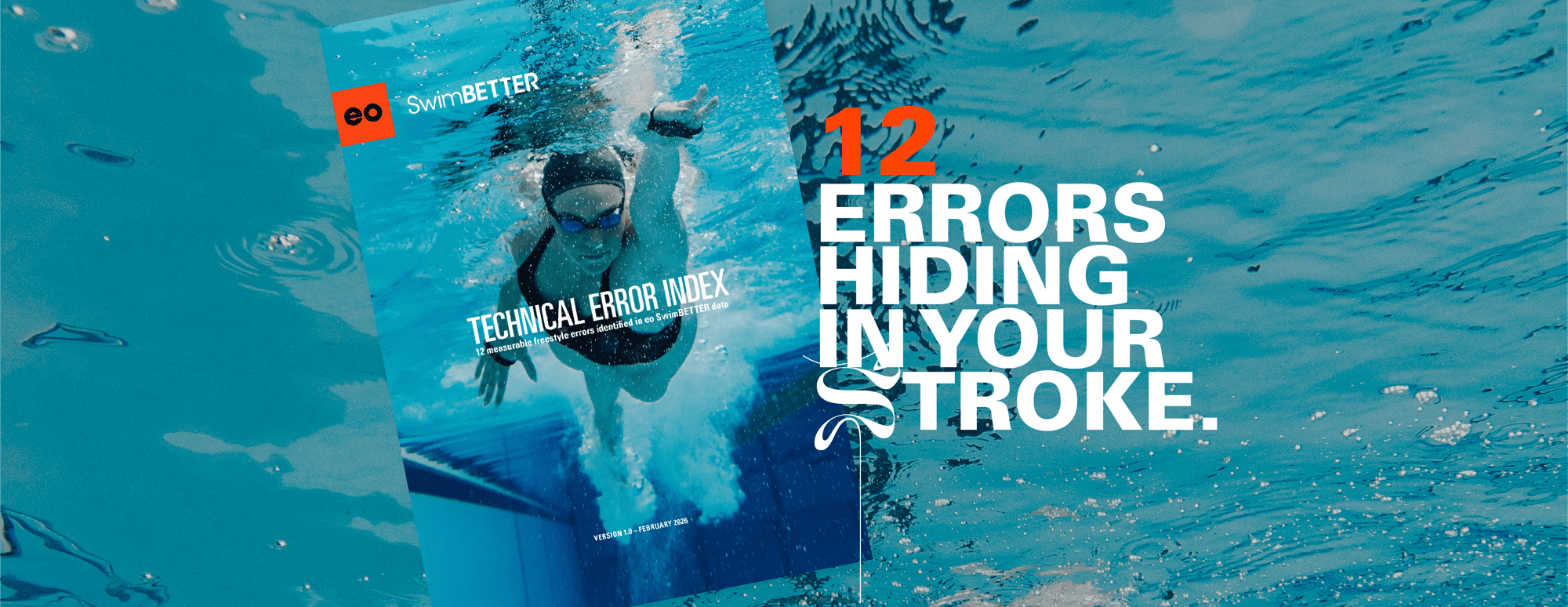
If you’re not measuring your stroke, you’re leaving performance on the table.
After analysing tens of thousands of swim sessions recorded with eo SwimBETTER by elite and competitive swimmers and triathletes, clear patterns began to emerge.
Patterns that are hard to feel – and almost impossible to see.
These patterns reveal the same freestyle errors again and again:
- Some reduce propulsion
- Some waste energy
- Some reveal asymmetries
- And most go completely unnoticed without data
You can’t fix what you can't see – start by seeing it.
Inside the Technical Error Index, you’ll find examples of common freestyle errors and how they show up in the eo SwimBETTER data, including.
- Propulsive imbalance between arms
- Excessive downward force
- Mid-stroke propulsion loss
- Stroke-to-stroke force variability
- Hand path asymmetry
- Early indicators of emerging shoulder dysfunction
Each section explains:
- What the data shows
- What it typically indicates
- Why it matters for performance
- What steps to take to make improvements
Get the free Technical Error Index
Where performance is won – and lost
Small technical inefficiencies compound with every stroke. Over a session – or a race – they become the difference between holding speed and falling off the pace.
The challenge? Most coaches can’t see them, and most swimmers can’t feel them.
Recognising these patterns helps swimmers, triathletes, and coaches focus on the changes that actually progress performance.
For swimmers
See where effort isn't translating into propulsion.
For triathletes
Improve swim efficiency and save energy for the bike and run.
For coaches
See what’s really happening in the stroke – not just what's visible on deck.
You’re missing more than you think.
Swimming technique has traditionally relied on observation and feel.
But when you measure how force is applied to the water, the data shows everything you’re missing.